Our mission
To create a little biobank for the future. Here at Noah’s plot in Ferryden of Forfarshire on the coast of eastern Scotland. And by the way, I’m no Noah but I know what Noah was doing.
(Thankfully) I cannot be here all the time, in our boreal winters, to provide the brought-in and bought-in food stuffs necessary for all those wintering and resident birds who should, by rights, be here, around this former fishing village and even in this tiny garden plot.
Therefore I must (as one must, as you might) struggle to create as diversified an ecological niche structure as possible. Great variety of and within the plot. A very small yard it is, but it could ultimately provide as much as 60 – 70% of the daily dietary needs of (in this case) three wintering Palearctic insectivores: the Wren, Robin and Dunnock. One day. Maybe only three years hence.
How is this to be achieved?
Currently the garden is only one third of the way through its first solar cycle. Since we took over management on February 20th 2024. At that time it was just a flat, bleak rectangle, of concrete and grass. Not many niches there. What can you do?
Well, might I suggest that one has to think like a fly? Or rather put yourself in the position of a fly. And thereby ascertain what the flies might need. There are a lot of fly species, even in the British Isles of today! So, when I write the word fly, … here, I do not mean simply those flies that an “average modern person” in the U.K. seemingly finds so repugnant or otherwise problematic.
Discovering the way of the fly
In the summer of 1998, a wet El Niño year in Scotland, I ramped up my interest in flies and became a “larval dipterist”. A friend to the maggot in other words.
Our son Lui (Laoigh in Scot’s Gaelic) was approaching two years of age, Elsie was expecting our second child and we had moved out of the city of Glasgow to a wood cutter’s cottage at Torinturk in mid Argyll.
A real hamlet, Torr-an- tuirc (meaning hill of the wild boar) is surrounded by multiphase commercial forestry. These plantation forests almost enclose numerous slivers of woodland “Triple S-I” – globally important patches of old growth temperate rainforest. Relatively sheltered from the Atlantic games along the shore of West Loch Tarbet, a fjord-like sea loch … on the way to Islay. The whisky island.
This then, is where I discovered the wonders of the world of the fly.
Lui’s pushchair was emblazoned with knurled handles of moulded plastic. Corrugated, colourful like ersatz tropical bark, corrugated in a covering of pastel pinks and softest blues. Just as one might expect of Mothercare at the end of the “naughty Nineties”.O
One summer’s afternoon, as we loitered in the occasional fleeting pools of warm sunshine, my first born and his absent minded dad, we witnessed various flies, some “hovers” in particular who would frequently alight to bask against the warm flower-hued plastic of the buggy.
That is how I discovered, as a birding new parent, that if life’s circumstance prevent you from “getting to the tanagers”, at least you can simulate that sense of wonder, like that being enjoyed (perhaps) by birding friends and acquaintances, in say the humid, temperate forests of the east slope of the Andes!
How so?
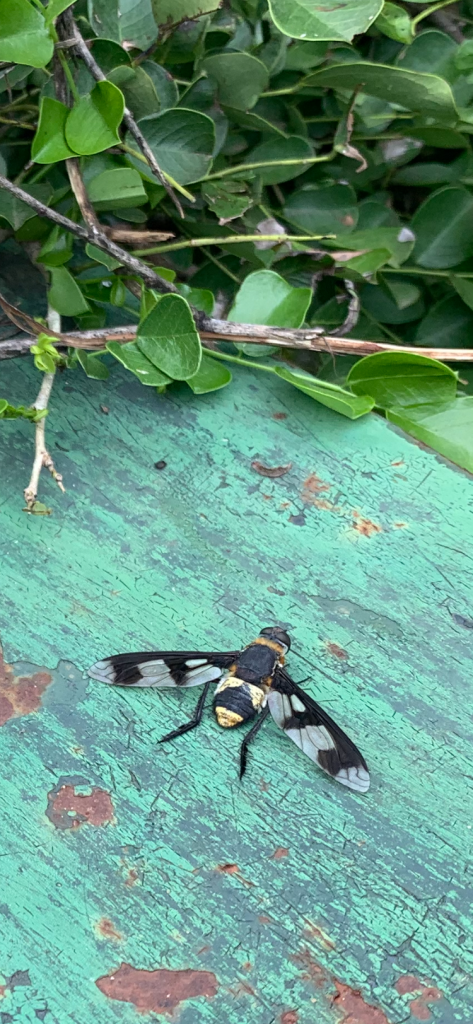
Simulate, by scaling-down one’s aspirations. To delight at the gleaming of dipteral exoskeletons. Even in the cold and gloom of Scotland to be beguiled by the banded black-and-gold of a social wasp mimic, or by the black and pulsating fascistic red-banded abdomen of other equally handsome hoverflies, those pretending (in a Bates-ian way) that they are spider-hunting wasps!
So, 1998, that is when I discovered that real ecology, in practice, is better understood by working one’s mind upwards, let’s say from the little world of the maggot to the greater freedom and majesty of the whale.
That is, when I realised that to successfully re-wild, ie to truly help conserve the world, you had first of all to liberate your imagination, and to think like a fly might. Cease your size-ist ways! And think outside the box, or yard. From the slime moulds to the stars!
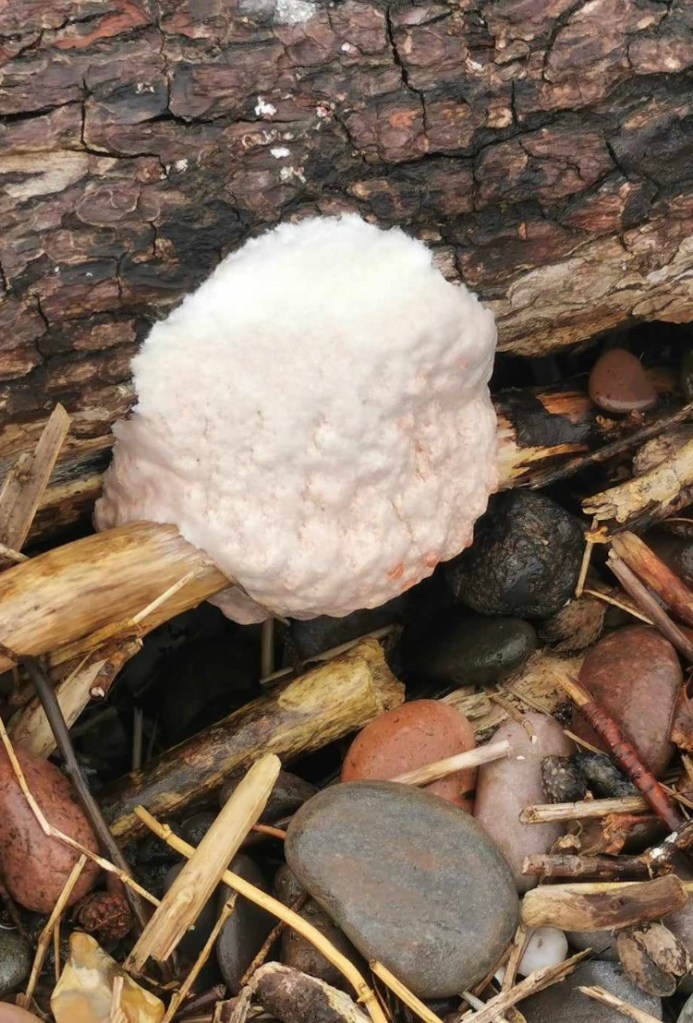
Up next : Ecologic Structural Shamanism – and the importation of substrates and seeds from local sites of low toxicity.
 Vagrant Mind